

















Formative assessment doesn’t have to mean more grading or complicated rubrics. When it’s done well, it looks like a natural part of your lesson: a quick pulse check that tells you what students really understand right now.
In this post, you’ll find fast, low‑prep formative assessment ideas you can use in five minutes or less, without adding another stack of papers to your desk. Because the last thing you need is to add another thing to your to-do list.
Why quick formative assessment matters
Too often, we discover misconceptions on a quiz or unit test, when going back feels almost impossible. By then, students are frustrated, you’re pressed for time, and everyone is ready to move on. Quick checks during instruction give you a chance to catch those misunderstandings while you can still do something about them.
A good five‑minute formative assessment is:
- Focused on one clear goal (“Can students explain…?”, “Can they apply…?”).
- Fast to give and fast to interpret.
- Low‑stakes or no‑stakes—students know it’s about learning, not points.
- Reusable across different lessons, so students learn the routine and you don’t have to reinvent the wheel each day.
When you build a small toolkit of these strategies, you can see patterns quickly, respond in the moment, and help students take more ownership of their learning.
No‑prep strategies you can use tomorrow
These ideas take almost no setup and can be dropped into a lesson at any point.
Fist to Five
Fist to Five is an incredibly simple way to gauge how confident your students feel with a concept.
- Ask: “Show me your understanding of ___ on a scale from 0–5.”
- Fist (0) means “I’m totally lost.”
- 1–2 means “I need more help.”
- 3 means “I kind of get it, but I’m not solid yet.”
- 4–5 means “I feel confident and could explain it to someone else.”
Take a quick scan around the room. If you see mostly 0–2, that’s your signal to pause and reteach or add another example. If the group is mixed, you can pair students who showed a 4–5 with those who showed a 1–2 and have them explain the concept in their own words.
Stoplight Colors (Red/Yellow/Green)
Stoplight checks are a visual way for students to share how they’re doing without having to say it out loud.
You can do this without any special materials:
- Ask students to draw a small red, yellow, and green circle on a corner of their paper, or use colored markers, sticky notes, or objects they have.
- Pause during or after a mini‑lesson and say: “Hold up your color: green if you’re ready to move on, yellow if you’re unsure, red if you’re confused.”
Again, scan the room. Cluster “reds” together for a quick small‑group explanation, and invite a few “greens” to share how they’re thinking with the class or with “yellow” partners. This gives you instant feedback and normalizes that it’s okay to be at different points in understanding.
One‑Sentence Summary
If students can say it clearly and concisely, they usually understand it.
Try prompts like:
- “In one sentence, explain how _____ works.”
- “Write one sentence that would help a student who was absent today understand the main idea.”
Give students two minutes to write. As they work, circulate and skim what they’re writing. You’re not looking for perfect grammar, you’re looking for whether they capture the key idea and vocabulary. You can then:
- Collect a handful (or just note what you see as you walk).
- Share two or three (anonymously) on the board or projector.
- Ask the class: “What’s strong about this summary? What could we clarify or add?”
This lets you correct misunderstandings in real time and models strong academic language.

Turn‑and‑Tell (Partner Share)
Turn‑and‑Tell doubles as a formative check and a speaking/listening practice.
- Pose a specific question: “Why did the character make that decision?” “How do we know which operation to use here?” “What pattern do you see in this data?”
- Ask students to turn to a partner and give each person 30–60 seconds to answer.
- Option: Call on a few pairs and ask them to share what their partner said, not their own answer.
As you listen in, you’ll hear common misconceptions, half‑formed ideas, and strong explanations. You can then decide whether to clarify for the whole group, highlight a strong response, or revisit part of the lesson. Of course you can always look for new ideas to tweak this method, too often things grow stale for us and for the students.
Exit Question on the Board
The classic exit ticket doesn’t have to be a full worksheet. One focused question can give you all the information you need.
- Before class, write a single exit question on the board or slide.
- At the end of the lesson, have students answer on a sticky note, index card, or in a notebook section labeled “Exit Tickets.”
Examples:
- “What is one thing you can now do that you couldn’t do at the start of class?”
- “Explain the most confusing part of today’s lesson.”
- “Solve this one problem and explain your reasoning in one sentence.”
On your planning period or after school, quickly sort the responses into three piles: “Got it,” “Almost there,” and “Not yet.” Use that to shape your opener for the next day—maybe a quick reteach for everyone, a small‑group review for the “Not yet” pile, or an extension task for the “Got it” group.
Low‑prep ideas that reuse what you already have
These strategies may require a tiny bit of setup once, but then you can use them again and again.
Sticky‑Note Parking Lot
A “parking lot” is a physical space in your classroom where student questions and confusions live until you can address them.
- Choose a spot on a wall or whiteboard and label it “Parking Lot” or “Questions.”
- At a set time—middle or end of class—ask students to write one question, confusion, or “I’m still unsure about ___” on a sticky note and post it there.
Later, you can group sticky notes by theme, turn common questions into a quick mini‑lesson, or answer several at the start of the next class. This shows students that their questions matter and gives you a clearer picture of what’s still muddy.
It’s also a great way to fill that extra time when an evaluator decides to “pop in” on your classroom for a surprise visit.

Quick “2-3-1” Reflection
The 2-3-1 reflection is simple, structured, and easy to reuse daily or weekly (Also called the 3-2-1, the number order doesn’t really matter).
Prompt students to write:
- 2 things you learned.
- 3 important details, facts, or examples.
- 1 question you still have or one thing you want to practice more.
Students can respond in their notebooks or on a half sheet they keep in a folder. When you skim their responses, pay special attention to the “1 question.” That line alone can tell you where to slow down next time, which skills to spiral back in, and who might be ready to move on.
Mini Whiteboard Check
If you have mini whiteboards (or page protectors with paper inside), you have a powerful, fast formative assessment tool.
- Pose 1–3 problems or questions aligned to your objective.
- Give students a minute or two to work and write their answers.
- Say “Boards up!” and have everyone hold their answers toward you at the same time.
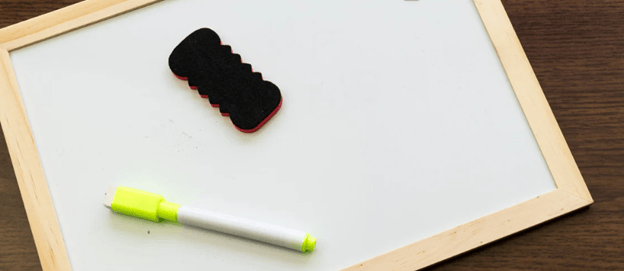
In one glance, you can see who’s correct, who’s close but has a minor error, and who has nothing written yet. You can then:
- Address a common error out loud (“I see a lot of you did ___, let’s fix that together.”).
- Call attention to one strong example and unpack why it works.
- Pull a small group while others move on to practice or enrichment.
“This or That” Concept Check
“This or That” forces students to make a choice and commit to an answer, which can reveal a lot about their thinking.
Give students two options and ask them to choose:
- “Is this example a metaphor or a simile?”
- “Is 3/4 closer to 0 or 1?”
- “Is this a primary or secondary source?”
They can show their choice by holding up a 1 or 2 on their fingers, writing A/B on their paper, or moving to a designated side of the room. If you see the class split, pause and have students explain their reasoning before you reveal the answer. The goal isn’t just to pick correctly, but to articulate why.
Using technology for five‑minute checks
If your students have access to devices, technology can streamline formative assessment even further. The key is to keep it short and focused.
One‑Question Polls or Quizzes
Most learning platforms, from your LMS to tools like Google Forms, allow you to create quick polls or quizzes.
- Create a one‑ to three‑question check aligned to your main objective.
- Give students a few minutes at the end of class or as a warmup the next day.
- Look at the results to see which question most students missed.
Instead of grading each response, use the summary view or charts many tools provide. That snapshot alone can tell you if you need to reteach, practice a skill, or just clarify one small point.
Digital Exit Tickets
Digital exit tickets work much like paper ones, but they’re easier to store and sort.
A simple template might include:
- “What did you learn today?”
- “What is one thing you’re still unsure about?”
- “Rate your understanding from 1–5.”
Because responses go into a spreadsheet, you can quickly filter by class period, question, or even rating. This is especially helpful for secondary teachers managing multiple sections.
Making quick checks actually change your teaching
Formative assessment only matters if it changes what happens next. The good news is that you don’t need a complicated data system to make that happen.
A few practical habits:
- Choose one or two go‑to strategies for the beginning of class (like a “This or That” warmup) and one or two for the end (like an exit question or Fist to Five). Consistency helps students participate more honestly.
- After each check, make one small instructional decision:
- Reteach briefly for everyone.
- Pull a small group for targeted support.
- Pair students for peer tutoring or explanation.
- Offer an extension or challenge to students who are ready.
- Don’t feel like you have to do this every day. You know your class, and how it will work best.
For your own records, aim for quick and simple:
- Jot a ✓, ~, or X next to student names on a roster while you scan their responses.
- Snap a quick photo of sticky‑note parking lots or whiteboards for later reference.
- Treat these checks as feedback, not grades. Students are more honest—and you get more accurate information—when they know it won’t hurt their average.
Bringing it all together
When you build a small repertoire of five‑minute formative assessments, you get a clearer window into student thinking without adding to your workload. Start small: pick one strategy for the middle of your lesson and one for the end, and commit to using them for a full week. You’ll start to see patterns in what students understand, where they get stuck, and which explanations really land.

If you’re ready to go deeper into designing meaningful assessments and using data to drive instruction, consider exploring graduate‑level courses that focus on assessment, curriculum design, or improving instruction. Investing a little time into sharpening your assessment toolkit now can pay off in more confident teaching,and more successful students,for years to come.
And you get to move over on the pay scale as well, which doesn’t hurt.